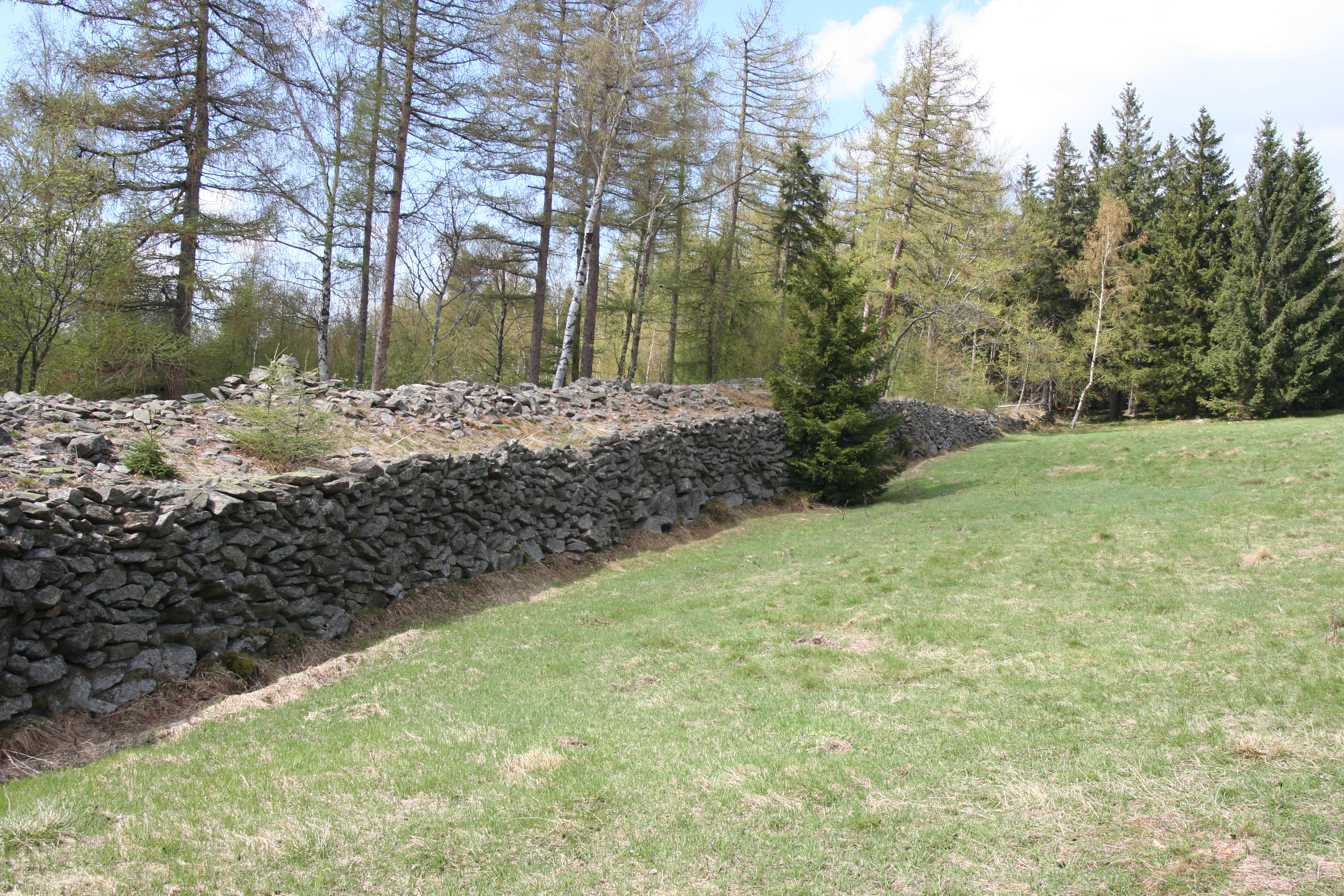
Why water is the primary threat
Frost, livestock pressure, and tree root encroachment all damage dry-stone walls, but water-related failure accounts for a disproportionate share of collapses. The mechanism is straightforward: water that cannot pass through or around a wall accumulates on the uphill side, increases the lateral pressure on the structure, and eventually finds the weakest point — usually a section where hearting has settled or where a through-stone is missing.
In upland Poland, where rainfall is higher than in the lowlands and where many field walls run across slopes, this is a persistent concern. The slopes of the Sudeten foothills and the Beskids receive between 700 and 1,000 mm of precipitation annually. Walls built perpendicular to the slope — crossing a drainage line rather than running parallel to it — are particularly exposed.
How dry-stone walls manage water
The open structure of a well-built dry-stone wall allows water to pass through the hearting zone between the two faces. Gravity pulls water downward through the gaps between stones, and the wall as a whole acts as a slow-draining medium rather than a dam. This is not a flaw in the construction — it is an intended feature. A wall that prevents water movement entirely would require substantial mass and a different structural approach.
The permeability of the wall depends on the cleanliness of the hearting material. Freshly built walls with well-packed stone fragments drain effectively. Over decades, fine particles — silt, organic material, clay — migrate into the gaps and reduce drainage capacity. This process is gradual and often invisible until a wet season reveals the problem in the form of a bulging or leaning wall face.
Slope and alignment
A wall running along a contour line is relatively low-risk from a drainage perspective, since water flows parallel to it rather than accumulating against it. A wall running down a slope creates a linear obstacle to cross-slope flow. Historically, farmers in upland Poland occasionally incorporated small drainage gaps at the base of walls crossing steep slopes — stones left slightly open, or a flat stone placed to create a culvert-like passage. These features are easy to miss during repair and are sometimes accidentally blocked.
Drainage risk indicators
- Wall runs perpendicular to slope direction
- Visible water staining on the downhill face
- Soft, wet ground on the uphill side after dry weather
- Moss or liverwort growth concentrated on one face
- Bulging in the lower third of the wall
- Previously mortared sections blocking original drainage gaps
Drainage gap construction
Where a wall crosses a defined drainage line — a seasonal channel, a field furrow, or a low point between two ridges — a drainage gap should be incorporated at the base. The simplest form is a single large flat stone placed horizontally to span the gap, with the space below kept clear of hearting material. This creates a low culvert passage that handles normal water flow without undermining the wall above.
The gap should be wide enough to pass the expected flow without creating a back-pressure effect, but not so wide that it weakens the base structurally. In practice, a gap of 20–30 cm is typical for agricultural field walls. Larger openings require a lintel stone strong enough to span the gap without cracking under the weight above.

Frost heave and winter drainage
In Polish uplands, ground frost penetrates to 60–80 cm in severe winters. Water held in saturated soil near a wall base expands on freezing and can displace foundation stones. Walls that sit in persistently wet ground — particularly in hollows or along stream margins — suffer repeated freeze-thaw cycles that gradually loosen the lower courses.
Addressing this requires improving drainage before it reaches the wall: redirecting surface water with shallow swales or ditches uphill of the wall, ensuring that any roadside or track drainage does not discharge toward the wall base, and avoiding the placement of organic material against the wall face, which retains moisture.
Vegetation and root pressure
Tree roots growing into the hearting zone are a slow but effective means of wall destruction. A mature ash or sycamore adjacent to an old wall will eventually force stones apart as roots expand. Smaller plants — brambles, elder — establish quickly in the nutrient-rich hearting and are harder to remove without partially dismantling the wall.
Maintaining a clear strip on both sides of a field boundary wall reduces vegetation pressure. This is easier to manage on the pasture side, where grazing animals keep growth low. The wall top is particularly vulnerable: once vegetation establishes there, root activity in the upper courses accelerates.
Repair approach when drainage has failed
A wall that has been pushed by water pressure usually shows a characteristic bulge on the downhill face and may have dropped in height on the affected section. Repairing the visible damage without addressing the drainage cause will result in re-collapse. The sequence should be: identify and clear the drainage blockage, allow the ground to dry, then rebuild the affected section with clean hearting material and leave any drainage gaps in their original positions.
Where the original wall had no drainage provision and the terrain requires it, a gap can be incorporated during repair. This involves removing a short section of the base and rebuilding with an open passage below — a modest intervention that substantially reduces future risk.
References
- Brooks, A. & Adcock, S. (1999). Dry Stone Walling: A Practical Handbook. British Trust for Conservation Volunteers.
- Dry Stone Walling Association of Great Britain — technical notes on drainage. dswa.org.uk
- Institute of Meteorology and Water Management (IMGW-PIB), Poland — precipitation data for mountain regions. imgw.pl
- Maciejewski, M. (ed.) (2007). Atlas Klimatu Polski. IMGW, Warsaw.